
Values in Action: How Helping Your Community Helps Your Mind
Living in the United States right now can feel overwhelming. With so many changes in the political and social world, it is common to feel a sense of worry or even a lack of control. For many LGBTQIA+ people and neurodivergent individuals, these feelings can be even stronger.
At Caretta Counseling, we know that your mental health is tied to the world around you. When the world feels unfair, it affects how you feel inside. One of the best ways to find your power again is through values-aligned behavior. This simply means making sure your daily actions match what you believe is important.
When we act on our beliefs, we feel more connected and strong. This blog post will explore how you can contribute to your community in ways that fit your unique energy and resources.
Key Takeaways
Values-aligned behavior helps reduce stress and improves your self-worth.
There is no "perfect" way to be an activist; both direct and indirect actions are vital.
Small actions that fit your specific abilities are just as meaningful as big ones.
What is Values-Aligned Behavior?
Think of your values as your internal compass. They tell you what matters most, like justice, kindness, or community. Values-aligned behavior is when you follow that compass.
When we feel like we should be doing something but we aren't, it creates a "gap." This gap can lead to feeling sad, anxious, or guilty. By taking action—even small steps—we close that gap. This helps us feel more "whole."
Research in positive psychology shows that helping others or standing up for what is right can actually lower stress. It gives us a sense of agency, which is the feeling that we have some control over our lives. For an autistic person or someone with ADHD, finding a specific way to help can also provide a helpful sense of focus and purpose.
Direct Ways to Contribute to Activism
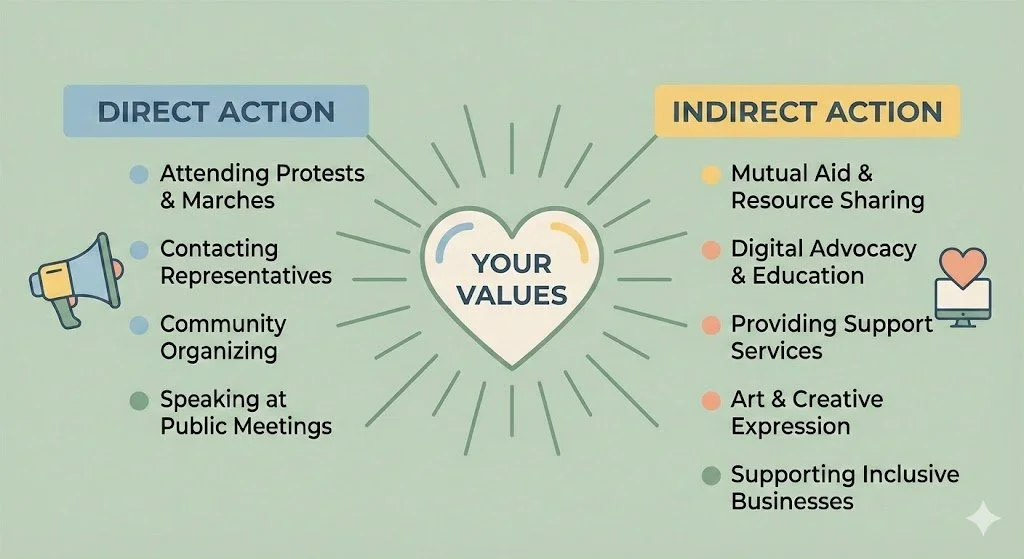
Direct activism involves "on the ground" work. These are actions where you are physically or vocally present to demand change. Here are a few ways to get involved directly:
Attending Protests or Marches: This is a powerful way to show numbers. Standing with a crowd can help you feel less alone and more connected to your community.
Contacting Your Representatives: Calling or writing to local and national leaders is a direct way to make your voice heard. It reminds them that they work for you.
Community Organizing: This could mean joining a local group that meets to plan events or help neighbors. It is about building power with the people living right next to you.
Speaking at Public Meetings: Going to a school board or city council meeting allows you to share your lived experience. Your story can change how leaders think about new laws.
Direct activism can be loud and busy. If you are a neurodivergent person who gets overwhelmed by crowds or noise, remember that you do not have to do these things to be "a good activist." There are many other ways to help.
Indirect Ways to Contribute to Activism
Indirect activism is the "behind the scenes" work that keeps movements running. These roles are just as important as being on the front lines. They are often more accessible for people who prefer quiet environments or have limited physical energy.
Mutual Aid and Resource Sharing: You can help by donating money, food, or supplies to local groups. This ensures that the people doing the hardest work have what they need to keep going.
Digital Advocacy: Sharing factual information and resources on social media helps educate others. You can use your online platform to lift up the voices of those who are often ignored.
Providing Support Services: Activists need childcare, meals, and emotional support. If you are a good cook or a great listener, you can support the movement by taking care of the people within it.
Art and Creative Expression: Creating posters, music, or writing can inspire others and spread a message of hope. Art is a language that can reach people’s hearts in a way that facts alone sometimes cannot.
Supporting Inclusive Businesses: Choosing to spend your money at queer-owned or neurodivergent-friendly businesses is a form of economic activism. It helps build a world where our community can thrive.
Why Your Contribution Matters
You might think, "I'm only one person, what can I really do?" In the current US political climate, it is easy to feel small. But movements are like a giant puzzle. Every piece—no matter how small or what shape—is needed to finish the picture.
If you are an autistic person, your ability to focus deeply on a topic might make you a great researcher for a local cause. If you have a lot of empathy, your role might be checking in on friends who are feeling burnt out. Your unique strengths are your best tools for activism.
Living your values is not about doing everything. It is about doing what you can, with what you have, from where you are. When you take that first step, you aren't just helping the world; you are also helping your own mental health.
Finding Your Balance
It is okay to rest. In fact, resting is part of the work. If you push yourself too hard, you may experience burnout. Burnout makes it harder to care for yourself and your community.
At Caretta Counseling, we encourage you to check in with yourself often. Ask, "Does this action make me feel energized or drained?" If you are feeling drained, it might be time to switch from direct to indirect action for a while.
Remember: You are enough exactly as you are. Your worth is not defined by how many protests you attend. It is defined by the kindness you show yourself and the ways you try to live your truth every day.
How We Can Help
If you are feeling overwhelmed by the state of the world or struggling to find your place in it, you don't have to carry that alone. At Caretta Counseling, we are here to support you.
Visit our website at https://www.carettacounseling.com/ to learn more about our affirming therapy services.
Explore our resources designed specifically for the LGBTQIA+ and neurodivergent communities.
Schedule a free 15-minute consultation today to see how we can work together to strengthen your self-worth and build your resilience.
Mandatory Disclaimers:
This is for informational purposes only and is not a substitute for professional therapy. If you are experiencing a mental health crisis, contact your local crisis center or the National crisis hotline at 988.
Sources
On Prosocial Behavior and Well-being: Curry, O. S., Rowland, L. A., Zlotowitz, S. J., McAlaney, J., & Whitehouse, H. (2018). Happy to help? A systematic review and meta-analysis of the effects of helping on the well-being of the helper. Journal of Happiness Studies, 19(5), 1567–1589. https://doi.org/10.1007/s10902-017-9861-y
On Values-Based Living (ACT Framework): Hayes, S. C., Strosahl, K. D., & Wilson, K. G. (2012). Acceptance and commitment therapy: The process and practice of mindful change (2nd ed.). Guilford Press.
On Civic Engagement and Mental Health: Ballard, P. J., Hoyt, L. T., & Pachucki, M. C. (2019). Impacts of adolescent and young adult civic engagement on health and socio-economic status in adulthood. Child Development, 90(4), 1138–1154. https://doi.org/10.1111/cdev.12998
On Managing Systemic Stress: National Institute of Mental Health. (2023). Coping with traumatic events. U.S. Department of Health and Human Services, National Institutes of Health.https://www.nimh.nih.gov/health/topics/coping-with-traumatic-events
